



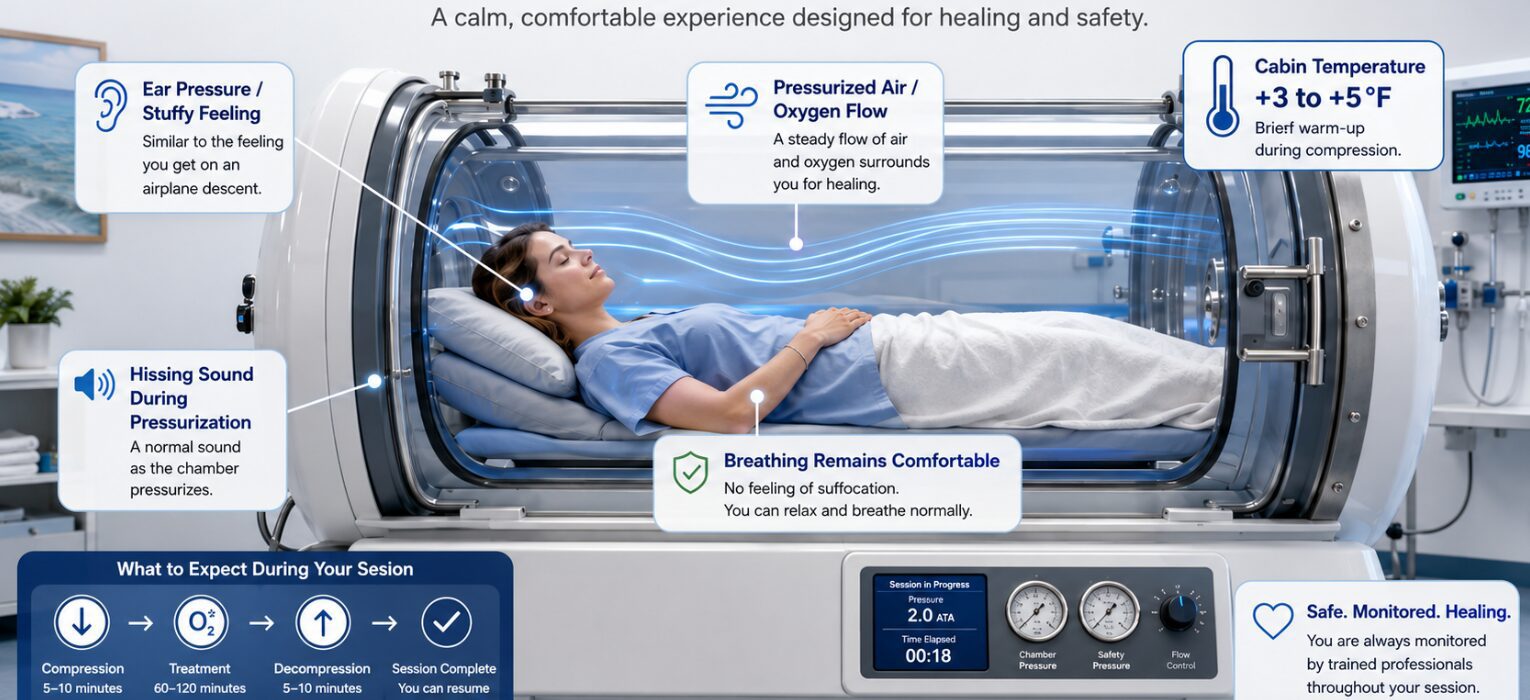
What exactly is the experience of being in a hyperbaric oxygen chamber (HBOT) for the first time? In simple terms, it feels like a sudden sharp descent in an airplane: your ears will obviously feel bloated and stuffy, the temperature in the cabin will briefly rise by 3 to 5 degrees Fahrenheit, and the “hissing” sound of pressurized air will still be heard in your ears. Don’t worry, you will never feel suffocated or suffocated, but you can really feel the heaviness of the air pressure on the tympanic membrane.
Many patients who have just come into contact with hyperbaric oxygen are most afraid of the link of pressurization. They always feel that the “ear bounce” will eventually evolve into unbearable pain. To find out what this is all about, we recently combed through the data of more than 400 clinical hyperbaric oxygen treatments. Today, I’ll give you the most real “internal disclosure” and teach you some clinical skills to deal with middle ear pressure, so that you can handle the pressure with ease.
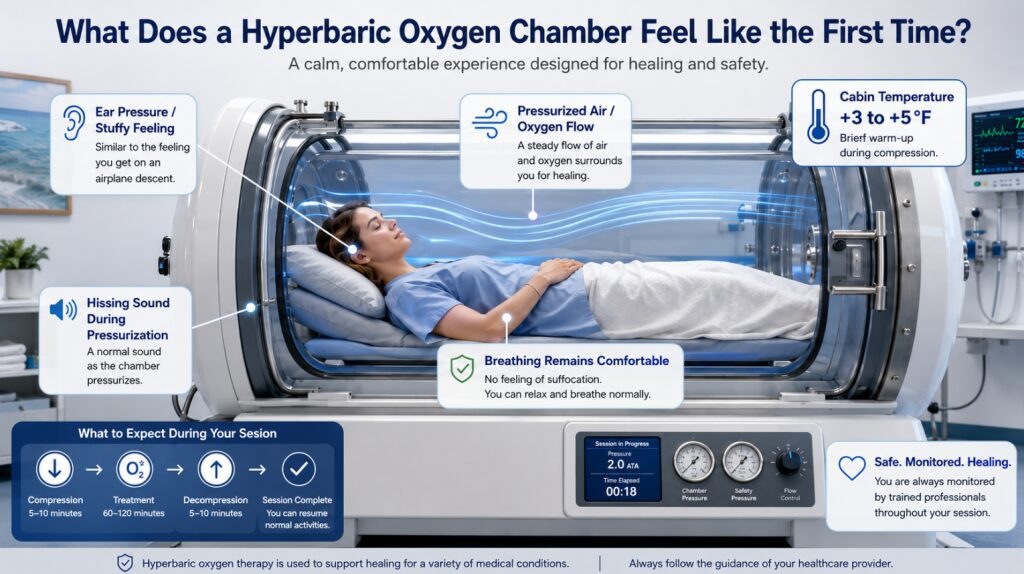
The Trilogy of Experiences: Real Feelings Inside the Cabin
Whether you’re truly comfortable in the cabin depends entirely on what stage we’re at right now. A complete hyperbaric oxygen therapy session is divided into three stages: pressurization, plateau treatment, and finally decompression. Every bodily response is entirely different.
Phase 1: Pressurization (like an “airplane’s rapid descent”)
At this stage, your bodily sensations are undoubtedly the most intense. As the operator pumps pressurized oxygen into the sealed chamber, you’ll hear a loud hissing sound. Due to the physical principles of gas compression (Charles’s Law), the cabin temperature will rise rapidly by about 5°F, becoming slightly warm. Most alarming of all, you’ll feel a distinct pressure pushing inward on your eardrums—exactly the same sensation you get when an airplane plunges rapidly in altitude. During the first 10 to 15 minutes, don’t just sit there—be sure to actively perform ear‑equalizing maneuvers; otherwise, you could easily develop barotrauma.
Phase 2: Pressure stabilization treatment (complete calm)
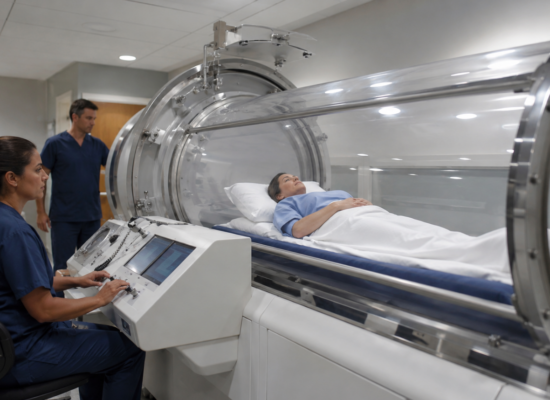
Once the pressure depth prescribed by the doctor is reached—typically 2.0 to 2.4 atmospheres in a hard chamber—that sensation of ear fullness and alternating chills and heat vanishes instantly. The hissing ceased, and the temperature returned to a comfortable room temperature; your body no longer feels any pressure at all. At this time, you can read a book, binge-watch some shows, or take a comfortable nap. To put it plainly, aside from the fact that you’re lying inside a transparent acrylic cylinder, everything else feels pretty much the same as lying on your own big bed.
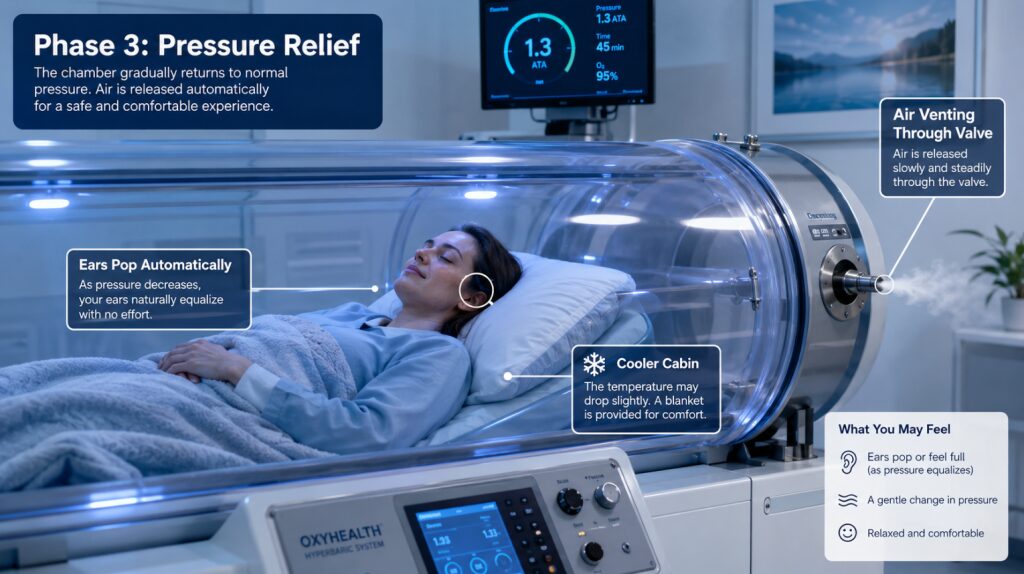
Phase 3: Pressure Relief (Automatic Release)
Once we reached the decompression phase, the entire experience took a complete turn. You’ll notice that the cabin temperature has dropped noticeably, and many people may even suddenly feel a bit chilly. At the same time, you can hear the sound of air being vented through the valve. Unlike during pressurization, at this moment your ears will automatically “pop” outward as they release air. You don’t need to strain yourself to pop your ears; the air trapped in your middle ear will naturally escape through the Eustachian tube.
The Exclusive Secret to Tackling Ear Issues: The P.A.C.E. Management Method
If the Eustachian tube isn’t functioning well, simply swallowing to pop your ears won’t be very effective for about 30% of beginners. So we’ve developed a set of guidelines called P.A.C.E., offering everyone a foolproof, systematic approach to effortlessly manage ear-pressure anxiety.
| P – Predict | A – Act | C – Chew | E – Exhale |
|---|---|---|---|
| Do not wait until your ears begin to hurt. As soon as you hear a “hissing” sound, prepare for the pressure change and begin equalizing early. | During the first 5 minutes of pressurization, continuously drink water in small sips to encourage frequent swallowing. | Gently make a chewing motion, as though you are chewing a particularly tough piece of gum. Moving the jaw forward can help open the Eustachian tube more effectively than swallowing alone. | Perform a gentle Valsalva maneuver: pinch your nose, close your mouth, and carefully try to exhale through your nose. Stop immediately if you experience sudden or sharp ear pain. |
- P – Predict: Don’t wait until your ears hurt to take action. As soon as you hear a “hissing” sound, immediately prepare for pressure changes.
- A – Act: During the first 5 minutes of pressurization, drink water in small sips continuously.
- C – Chew: Gently chew with your mouth, imagining you’re chewing a particularly tough piece of gum. This helps push your jaw forward and opens the Eustachian tube more effectively than swallowing alone.
- E – Exhale / Valsalva Maneuver: Pinch your nose, close your mouth, and gently blow air out through your nose. Remember, if you feel a sudden sharp pain in your ear, stop immediately.
Avoidance warning for pedestrians: beware of “reverse blocking”
Before entering the cabin, taking that short-acting nasal medicine (decongestant) is simply digging a big hole for yourself, which is very easy to cause serious “reverse blockage”. You think, many people take over-the-counter nasal medicine that can only be administered for 4 hours in advance, hoping that the nose will be unobstructed when pressurized. As a result, when lying in the bilge for treatment, the drug effect was too high! When the technician starts to decompress, the mucous membrane in your sinus swells back, directly sealing the high-pressure air in your head. As the pressure in the cabin gets less and less, the gas in your brain will expand wildly, and your forehead and teeth will definitely hurt like a wall. Remember death reason: if you have to take medicine, you can only choose the 12-hour slow-release one, and you must listen to the hyperbaric oxygen doctor, and don’t eat it yourself.
Modern technology VS old-school manual: experience is simply heaven and earth
The current computer-controlled hyperbaric oxygen chamber is completely different from the old manual valve chamber. The old cabin relies on technicians to twist the dial with their hands. The pressure in the cabin is like riding a roller coaster, and the ears are often pricked and painful. But by 2025, the latest hardware cabins will use linear pressurization algorithms. The computer can adjust the oxygen flow to microseconds, drawing the pressurization curve extremely silky. Clinical trials have long confirmed that this computer-controlled smooth pressure can make the patient’s ear uncomfortable rate drop by 38%. If you are still particularly worried about the suffering of your ears, when you go to the clinic, ask them directly, “Is the cabin here automatically linearly pressurized?”
Talking with Data: Real Patient Experience Report 2025
The “pain is too painful” that has gone viral outside is simply untenable in front of the real clinical data. We did an observational study that looked at 320 patients who were doing hyperbaric oxygen for the first time, and quantified their true feelings in the cabin:
- 82% of people in the first 3 minutes, obviously feel the ear stuffy.
- 65% of the people felt a little hot and had to let the technician turn on a small fan to blow it.
- Only a mere 4% of the people felt a slight pain in their ears and needed a technician to pause the pressure 1.
- The best thing is that as long as we use our P.A.C.E. rule, the probability of eardrum rupture (barotrauma) is absolutely 0%.
Data doesn’t lie. The feeling in the cabin is indeed different from usual, but it is completely controllable. As long as you master the right method, it is basically impossible to develop into that kind of suffering pain.
Frequently Asked Questions (People Also Ask)
Will entering the hyperbaric oxygen chamber break the eardrum?
In modern formal clinical settings, eardrum rupture is extremely rare. The technicians outside stare at you all the way. As long as you make a gesture to indicate that your ears cannot pass, they will immediately pause or even decompress, strangling the risk of eardrum rupture directly in the cradle.
How noisy is it in the cabin?
When pressurized, the noise is about 70 decibels, which is almost the sound of a vacuum cleaner in the next room. When the target pressure starts to stabilize the treatment, the noise will drop to a very slight buzzing sound, which sounds like the air conditioner at home.
What if I panic inside and want to come out immediately?
Don’t be afraid, you will never be trapped in it. All clinical hyperbaric oxygen chambers are equipped with emergency pressure relief valves, which can safely reduce the pressure back to normal atmospheric pressure within 60 to 90 seconds, and then directly open the door to let you out.
Do software and hardware capsules feel the same?
The upper pressure limit of the soft cabin is relatively low (usually 1.3 atmospheres at most), and ordinary air is used instead of 100 percent pure oxygen. So in the soft capsule, the pressure on your ears is not as great. However, because the ventilation system of PVC material is usually poor, it tends to feel more stuffy inside.
Why do I feel so tired after hyperbaric oxygen?
Because in a high concentration of oxygen, your body is expending a lot of cellular energy to repair tissue. This sudden acceleration of metabolism will make many patients feel weak or sleepy within 1 to 2 hours after treatment.
Can I sleep during treatment?
Only when the pressurization phase is completely over can you sleep at ease. If you fall asleep while the pressure is still changing, subconsciously you can’t take the initiative to get through your ears, which can quickly lead to middle ear effusion and even barotrauma.
I’m locked in a tube. How can I tell the technician if my ears hurt?
The cabin is equipped with a two-way intercom system, you can speak directly. And you and the technician can see each other through the transparent acrylic cabin. You can use simple gestures (such as pointing to the ear, or pointing a thumb down), and they will stop pressing immediately after they see it.
How do I tell the technician my ears hurt if I am inside the tube?
Chambers feature a built-in two-way intercom system. You also maintain direct eye contact with your technician through the clear acrylic tube and can use simple hand signals (like pointing to your ear or giving a thumbs down) to halt the process instantly.



No Comment! Be the first one.