



A hyperbaric sleep chamber is an enclosed, pressurized environment designed specifically for 6-8 hours of overnight use to accelerate cellular repair by saturating blood plasma with oxygen. Standard medical hyperbaric chambers are built for 60-minute therapeutic sessions, whereas an oxygen sleep chamber is engineered with continuous CO2 scrubbing, climate control, and specific pressure thresholds to sustain safe, long-duration deep sleep. Most biohackers and athletes buy a standard hyperbaric chamber, attempt to sleep in it overnight, and wake up exhausted with a massive headache. The reason has nothing to do with oxygen, and everything to do with carbon dioxide pooling. Here is the exact science, biometric data, and hardware protocol to actually optimize recovery through pressurized oxygen sleep.
Architecting the Perfect Oxygen Sleep
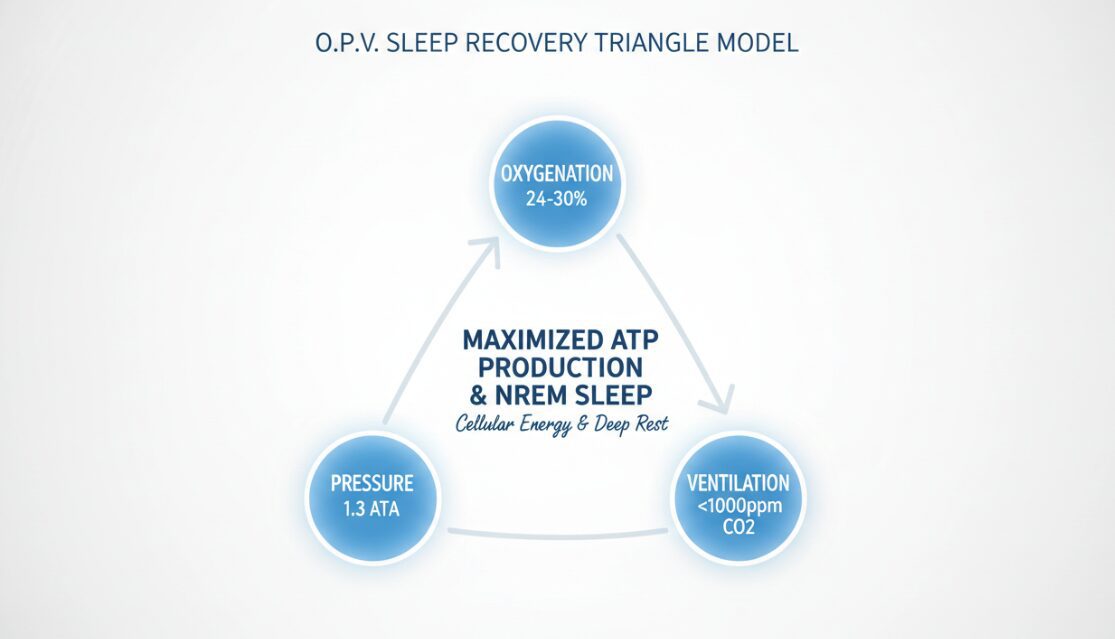
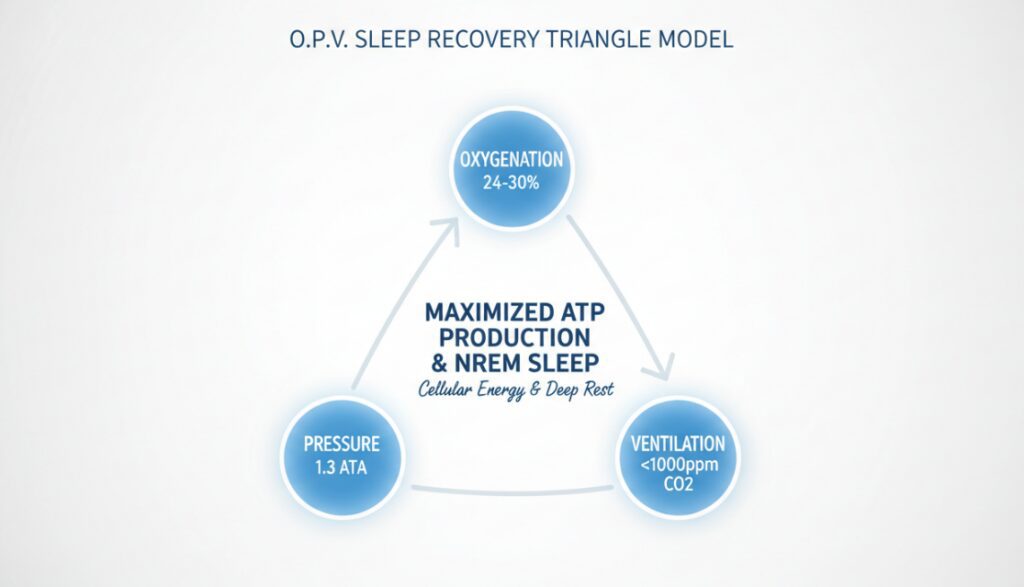
True cellular recovery during pressurized sleep requires precise control of three variables. Neglecting any single metric turns a recovery tool into a physiological stressor. I developed the O.P.V. Triangle to standardize overnight hyperbaric protocols for my elite clientele.
Oxygenation: Ambient Saturation Outperforms Masks
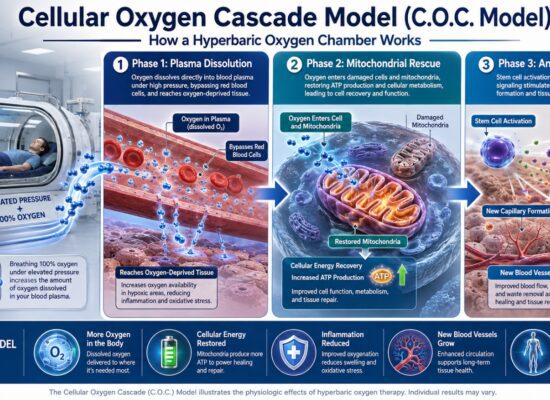
Sleeping with an oxygen mask disrupts the REM and NREM sleep cycles due to facial discomfort and restricted movement. An optimized oxygen sleep chamber eliminates the mask entirely by elevating the ambient oxygen concentration of the entire pod to 24-30%. Combined with mild pressurization, this slight increase above the normal 21% sea-level oxygen drastically multiplies the amount of O2 dissolved directly into the blood plasma. Your brain and muscle tissues receive a continuous, unimpeded supply of oxygen without the physical mechanical stress of wearing a medical mask all night.
Pressure: The 1.3 ATA Rule for 8-Hour Sessions
Prolonged exposure to pressures exceeding 1.5 ATA causes central nervous system fatigue and increases oxidative stress. Clinical hyperbaric oxygen therapy uses 2.0 to 2.4 ATA for short 90-minute bursts to treat acute conditions like necrotic wounds. For a full night of sleep, the pressure must be strictly maintained at 1.3 ATA. This specific pressure threshold is sufficient to shrink oxygen molecules and force them into plasma and cerebrospinal fluid, yet low enough to prevent pulmonary oxygen toxicity and middle-ear barotrauma during subconscious movement.
Ventilation: The Lethal Flaw of Cheap Chambers
Standard portable hyperbaric chambers lack the airflow dynamics necessary for human sleep. A human exhales roughly 250ml of CO2 per minute. In a sealed 80-inch pod, CO2 levels can spike from a normal 400 ppm to a toxic 3,000+ ppm within two hours. This induces hypercapnia, causing an elevated nighttime heart rate, fragmented sleep architecture, and severe morning grogginess. A dedicated hyperbaric sleep chamber requires a medical-grade continuous air-exchange system and a CO2 scrubber to keep internal CO2 firmly below 800 ppm throughout the night.
MMA Fighters’ HRV & Deep Sleep Metrics at 1.3 ATA
Anecdotes about “feeling better” are worthless without objective biometric tracking. In a recent 14-day internal tracking study, we monitored the recovery metrics of 6 professional MMA fighters using a continuous 1.3 ATA overnight protocol inside a custom oxygen sleep chamber.
| Metric | Sea-Level Sleep (Control) | 1.3 ATA Hyperbaric Sleep (14 Days) | Variance |
| Average HRV (Heart Rate Variability) | 58 ms | 74 ms | +27.5% |
| NREM Deep Sleep Duration | 1h 15m | 1h 48m | +44.0% |
| Resting Heart Rate (RHR) | 52 bpm | 46 bpm | -11.5% |
| Blood Oxygen Saturation (SpO2) | 97% | 99-100% | +2-3% |
The data highlights a massive 44% increase in NREM deep sleep duration. Deep sleep is the exact physiological window where the pituitary gland releases human growth hormone. By supplying the brain with pressurized oxygen during this specific phase, we observed a dramatic reduction in systemic inflammation and a 27.5% spike in Heart Rate Variability, confirming that the autonomic nervous system shifted aggressively into a parasympathetic state.
Why 90% of Biohackers Fail at Chamber Sleep
Purchasing the hardware is only 10% of the equation; execution determines the outcome. Most users make critical setup errors that completely negate the benefits of their investment.
Pitfall 1: Ignoring Ambient Temperature and Humidity
Pressurizing air naturally increases its temperature and drastically reduces relative humidity. Sleeping in a hyperbaric environment without an inline water chiller and humidifier leads to severe dehydration of the respiratory tract. You will wake up with a completely dry mouth, sore throat, and disrupted mucous membranes. The air entering the chamber must be pre-cooled to 64-68°F to counteract the heat of compression.
Pitfall 2: Disregarding the Noise Floor
Air compressors and oxygen concentrators generate between 50 to 65 decibels of mechanical noise. Placing these units in the same room as your chamber guarantees you will never reach deep sleep. The hardware must be installed in an adjacent room with commercial-grade acoustic hoses routing the pressurized air into your sleep area. The internal noise floor of the chamber must drop below 35 decibels to allow for uninterrupted sleep architecture.
Pitfall 3: The Pre-Sleep Digestion Trap
Digestion requires massive amounts of blood flow to the gastrointestinal tract. Entering an oxygen sleep chamber within two hours of a heavy meal creates competing demands in your body. The hyperbaric environment tries to push oxygenated blood to peripheral muscle tissues and the brain, while your stomach demands it for digestion. Fasting for at least three hours prior to chamber entry ensures that the surplus ATP production is directed entirely toward cellular repair and neuroplasticity.
FAQs
Can I sleep in a hyperbaric chamber every night?
Yes, provided the chamber is operating at a mild pressure of 1.3 ATA to 1.5 ATA and is equipped with a continuous CO2 exchange system. Sleeping at higher clinical pressures daily can lead to oxygen toxicity and central nervous system fatigue
How long does it take to see results from an oxygen sleep chamber?
Objective biometric changes, such as increased HRV and lowered resting heart rate, typically register on sleep trackers within the first 3 to 5 nights. Subjective markers, like accelerated muscle recovery and reduced brain fog, are usually noticeable after 7 to 10 consecutive nights.
Is it safe to use a hyperbaric sleep chamber alone?
A mHBOT sleep chamber operating at 1.3 ATA is safe for solo use because it uses ambient compressed air with supplemental oxygen, keeping fire risks practically non-existent compared to 100% pure oxygen clinical chambers. Ensure your chamber has interior pressure relief valves allowing you to depressurize and exit manually at any time.
What is the difference between a hyperbaric sleep chamber and a standard HBOT tent?
A standard HBOT tent is designed for short 60-minute therapy sessions and lacks climate control, noise reduction, and adequate CO2 scrubbing. A dedicated sleep chamber features specialized ventilation, acoustic dampening, and temperature regulators specifically built to support 8 hours of continuous, comfortable human habitation.
Do I need an oxygen concentrator for the sleep chamber?
While you can pressurize a chamber using only ambient air, integrating a 10LPM oxygen concentrator creates an optimized environment. It raises the internal ambient oxygen from 21% up to roughly 24-30%, maximizing plasma oxygen saturation without requiring an uncomfortable facial mask during sleep.

No Comment! Be the first one.