



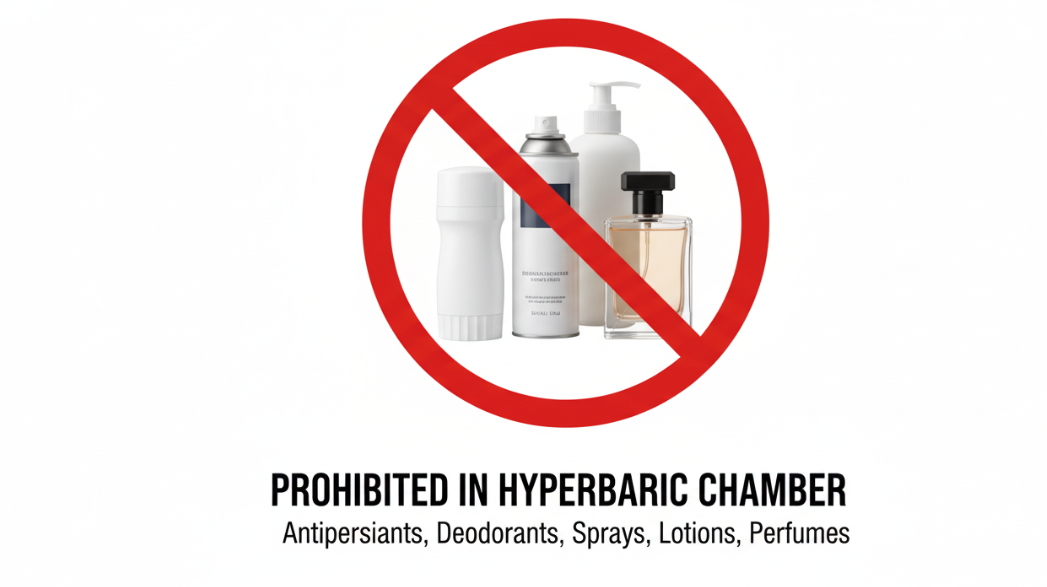
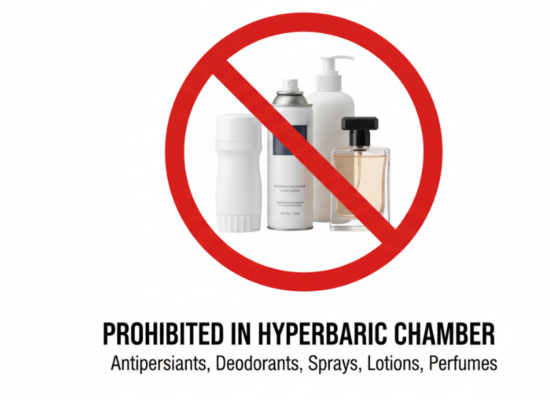
You cannot wear deodorant in a hyperbaric chamber because it creates a significant fire hazard that puts both you and the medical staff at risk.
During hyperbaric oxygen therapy (HBOT), you breathe 100 percent pure oxygen under pressure. In this extremely oxygen-rich environment, the form of fire is completely different from that in atmospheric air-once a fire starts, the burning speed will be extremely fast, the flame temperature will be extremely high, and the destructive power will increase exponentially. Most antiperspirants, deodorants and personal care products on the market contain petroleum-based oils, alcohol or synthetic fragrances, all of which are highly flammable. Once these things remain on your skin or clothing, they become excellent fuel; in this environment, even the slightest spark of static electricity that you don’t even feel can cause a catastrophic burning accident. In order to follow safety guidelines, your skin must be absolutely clean and dry before entering the hyperbaric chamber, without any oils, emulsions or chemical residues.
Fire Science In Hyperbaric Oxygen Environment
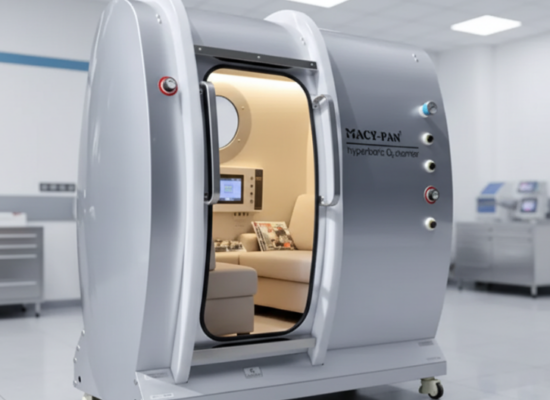
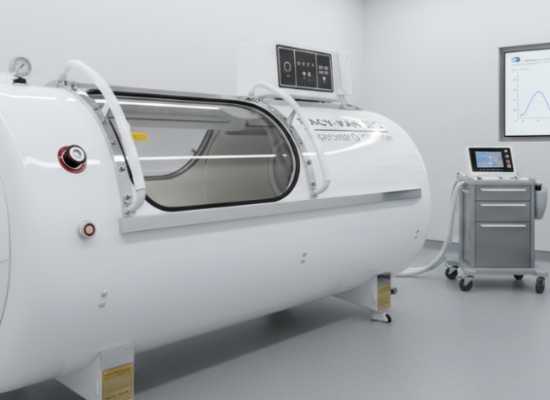
To understand why these daily necessities are strictly prohibited, you need to understand what kind of environment a hyperbaric oxygen chamber is. The air we usually breathe contains only about 21 percent oxygen, while the HBOT cabin is filled with 100 percent pure oxygen and is pressurized.
At atmospheric pressure, three elements are required to sustain combustion: fuel, heat, and oxygen. In the hyperbaric oxygen chamber, the condition of “oxygen” has been “overloaded.” When you bring in the oil or alcohol that’s in the antiperspirant, you’re essentially putting combustion aids into an environment that’s already highly susceptible to accelerated combustion. The air pressure in the cabin will further compress these gases, causing a fire to spread rapidly and cannot be controlled.
Why Do These Care Products Become “Fuel”?
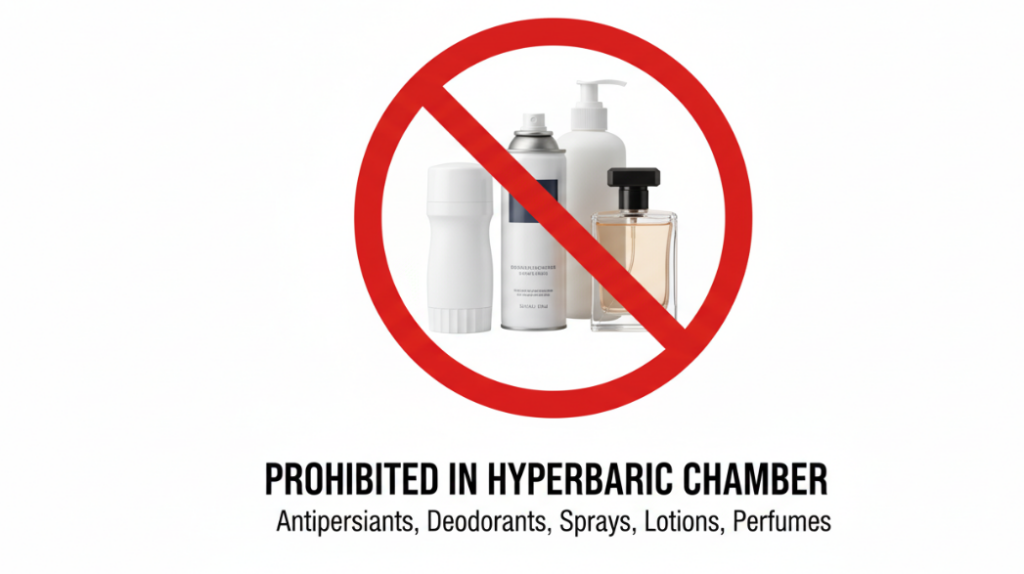
Many patients before entering the cabin, completely unaware that their usual application of antiperspirant is a huge safety hazard. Antiperspirants and deodorants are designed to adhere tightly to the skin, and in order to achieve this effect, they usually contain the following ingredients:
Petroleum-based oils: These are actually hydrocarbons. In a pure oxygen environment, as long as they come into contact with a little heat source, their chemical reactions will be very intense.
Alcohol: Many products use alcohol as a solvent or desiccant. Everyone should know how volatile alcohol is, and its ignition point is lower than ordinary household materials.
Synthetic flavors: These concentrated chemical compounds often act directly as combustion aids in the cabin.
Even if you feel that you have washed clean in the bath, these ingredients will still remain on the surface of the skin in the form of a film invisible to the naked eye. As long as there is friction, static electricity or electrical failure in the cabin, this seemingly insignificant film can instantly become the ignition point, resulting in irreparable consequences.
Harsh Safety Guidelines Cannot Be Compromised
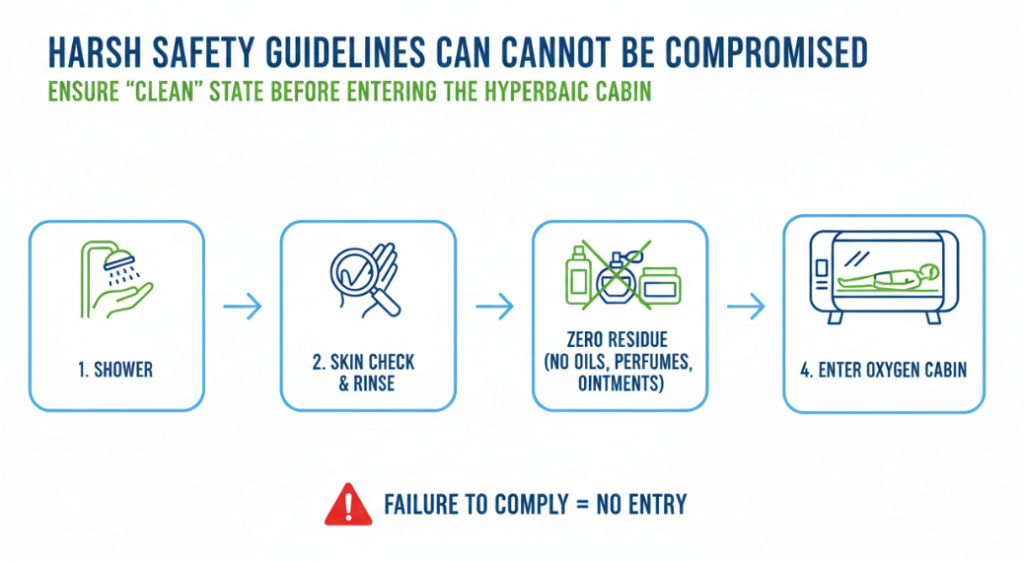
In order to ensure the safety of every who enter the cabin, our clinical guidelines clearly require that patients must be present in a “clean” state.
In my line of work, my definition of “clean” is clear: it’s not just about taking a shower, it’s about making sure there’s nothing on the skin:
Emollient oils and emulsions: They usually contain oils and fats and are flammable.
Perfumes and colognes: These contain alcohol and have the same risks as antiperspirants.
Ointments: No ointment is allowed to be brought into the capsule unless specifically approved by the doctor.
Before each treatment, our medical staff will usually request a check-up. If you apply antiperspirant and forget to wash it off, I can only let you scrub that part thoroughly, otherwise you must not enter the cabin. This may take a little time, but I would rather make you feel a little inconvenience than risk even one in ten thousand on safety.
Safety Above All
You can cooperate with our care restrictions, which is the most important step to prevent the accident of hyperbaric oxygen therapy. Keeping your skin free of antiperspirants, lotions and other flammable personal care products is not just about complying with the rules-it’s about taking responsibility for yourself, and for the lives of other patients and health care workers in the cabin.
Remember to adhere to the “clean skin” principle before planning each treatment. This is the line of defense in all our security efforts.
Author: Dr. Elena Vance
“Hi, I’m a Hyperbaric Safety Specialist with over 15 years of experience in clinical oxygen therapy. My daily mission is to ensure that every patient who enters our hyperbaric chambers returns home safely. Through my years of practice, I have seen firsthand how critical minor details—like the products on your skin—can be in a high-pressure, oxygen-rich environment. I write to demystify these ‘harsh’ safety rules, helping patients understand that our strict protocols are the most effective way to protect lives.”

Pas de commentaire ! Soyez le premier.