



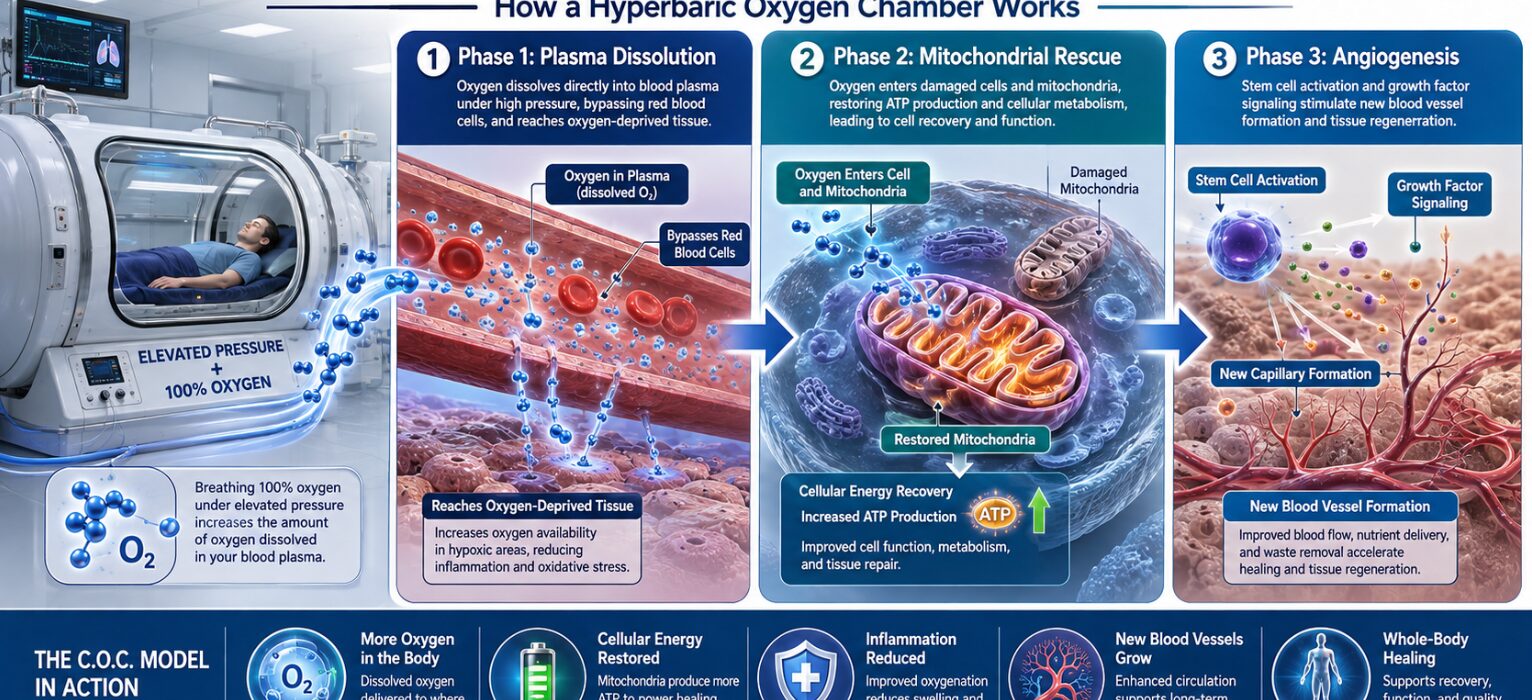
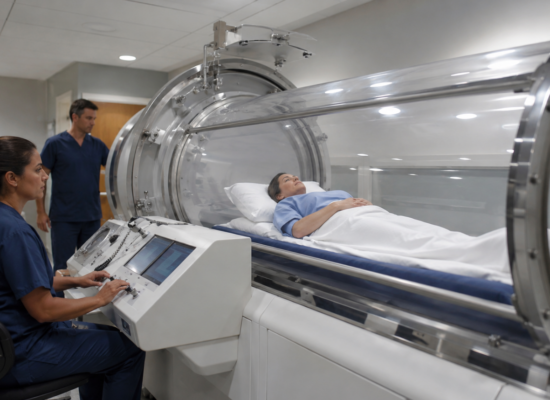
How exactly does a hyperbaric oxygen chamber work? Simply put, it uses elevated pressure to force pure oxygen directly into your blood plasma, effectively bypassing the red blood cells and delivering life‑saving oxygen to oxygen‑deprived tissues at the cellular level.
Many patients misunderstand hyperbaric oxygen therapy (HBOT), believing it merely helps people “breathe more easily.” But the reality is far more astonishing: under such extreme pressure, the fundamental principles of human biology are reversed—your gene expression is altered, vast numbers of stem cells are activated and mobilized, and even dying cells are compelled to re‑engage in regeneration. If you want to truly harness this clinical tool and avoid wasting time in the hyperbaric chamber, you must understand how it precisely targets and repairs cells. Next, let’s delve into what kind of biological cascade is actually unfolding inside your cells the moment the hatch closes and the pressure rises.
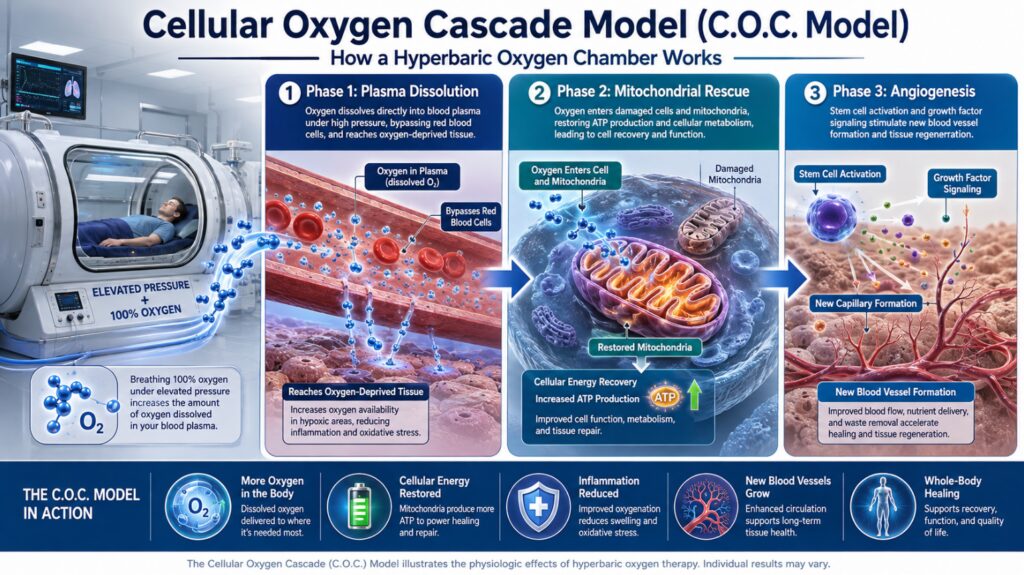
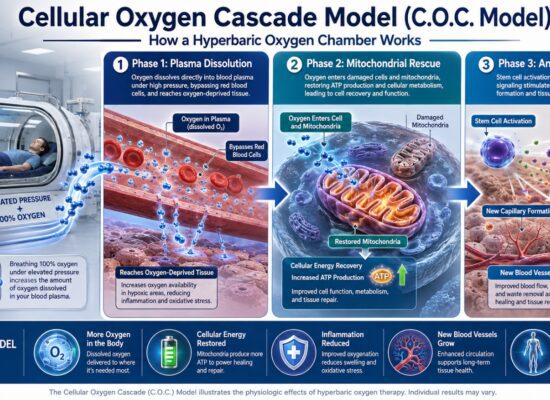
Cellular Oxygen Cascade (C.O.C.) Model
In daily breathing, the oxygen we inhale is completely dependent on the hemoglobin in the red blood cells to carry it. Once these red blood cells are “full”, no matter how big you breathe, your body can’t absorb more oxygen at normal atmospheric pressure. The Cellular Oxygen Cascade (C.O.C.) model explains just how hyperbaric oxygen can force around this physical limit.
Phase 1: plasma dissolution (Henry’s law)
As the cabin pressure rises, oxygen is forced to dissolve directly into the plasma, cerebrospinal fluid, and lymph. Behind this is actually the classic “Henry’s law” in physics-the solubility of a gas in a liquid is proportional to the pressure of the gas. You know, when blood vessels are swollen, inflamed or damaged, red blood cells are often blocked out because they are too big. But unlike plasma, it can easily pass through these focal roadblocks, sending ultra-high concentrations of oxygen-rich liquid directly to tissues that are dying from lack of oxygen.
Phase 2: Mitochondrial Rescue
When oxygen-filled plasma floods into damaged cells, the 1 field’s “rescue” of depleted mitochondria is launched. Mitochondrial synthesis of ATP (3 adenosine monophosphate, the “universal currency” of cell repair) requires massive amounts of oxygen. Damaged tissues are often in the energy crisis of ATP shutdown, and hyperbaric oxygen is like reigniting this biological engine, allowing fibroblasts (responsible for repairing wounds) and osteoclasts (responsible for bone healing) to turn on their full power again and go crazy for tissue synthesis.
Phase 3: Epigenetic Reprogramming
Long-term repair of cells depends on permanent changes in DNA expression. Long-term exposure to hyperbaric oxygen will trigger a process called “angiogenesis”, that is, new microvessels grow on the basis of the original blood vessels. This is equivalent to permanently building a new blood network in your body. Even if you have finished the treatment and left the oxygen chamber, it will still continuously nourish the newly repaired tissue.
| Comparison Dimension | Standard Oxygen Delivery (1 ATA) | Hyperbaric Oxygen Delivery (1.5–2.4 ATA) |
|---|---|---|
| Oxygen Carrier | Primarily red blood cells | Red blood cells and oxygen-rich plasma |
| Pénétration des tissus | Low | High |
| Angiogenesis | Not typically triggered | Triggered with repeated treatment |
The Hypoxia-Hyperoxia Paradox: The “Start Switch” of Stem Cells”
You may not think that the deepest healing response is not achieved by maintaining a high concentration of oxygen, but by a “sharp drop” in oxygen concentration “. The Hypoxia-Hyperoxia Paradox (HHP) demonstrates that rapidly switching between an extremely hyperoxic environment and a normoxic environment can successfully “trick” the body into releasing massive amounts of regenerative stem cells.
When a treatment is about to end and the oxygen concentration suddenly drops, your body will mistakenly think that you have suffered a serious hypoxia crisis. This false sense of threat causes the body’s hypoxia-inducible factor 1-alpha (HIF-1 alpha) to stabilize. As the commander-in-chief, HIF-1 alpha will signal the bone marrow wildly, causing the number of CD34 stem cells released into the blood to soar to as much as eight times the usual number! In other words, you’re not only earning the stem cell burst dividend from hypoxia for nothing, but you’re not risking a real hypoxia in your brain or tissue at all.
Pit Avoidance Guide: Pressure Value (ATA) Matching Trap
Many patients feel that the treatment is not effective, often because the air pressure (ATA) set for them by the clinic is completely symptomatic. If the pressure is simply and roughly filled with all diseases, it will trigger oxidative stress and directly stall the cell repair process.
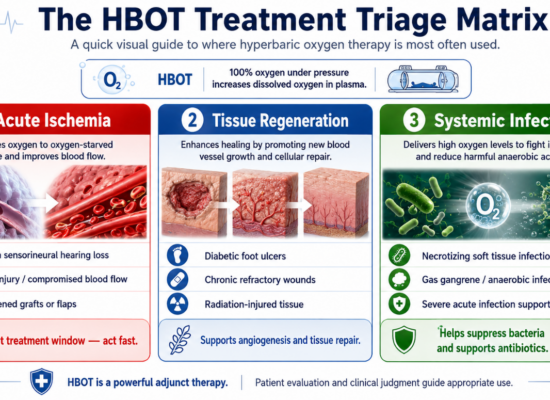
For example, when treating radiation necrosis or diabetic foot ulcers, it is indeed necessary to 2.0 a strong pressure of 2.4 ATA, so that oxygen can be forced deep into the dense dead skin tissue. But in the field of nerve repair, the game is completely different. If you want to repair traumatic brain injury (TBI), stroke sequelae or neuritis, 1.3 to the mild and high pressure of 1.5 ATA is the best solution. If a brain injured patient has to be stuffed into an ATA -2.4 environment, it will only lead to oxygen toxicity, forcing the brain to contract blood vessels, and completely stifling the neuroplasticity that the patient needs most. Remember, the pressure value must be precisely matched to your cellular target.
Real-Case Tracking: A Record of Diabetic Foot Wound Healing
How long is the oxygenation timeline of cells under high pressure? Clinical data have provided us with a definitive answer. We once followed a 58-year-old patient with diabetic foot ulcers whose wounds had remained unhealed for years. Throughout the entire 40-session treatment course, we used transcutaneous oxygen tension (TcPO2) technology to monitor in real time the delivery of oxygen to the skin cells.
Prior to treatment, the baseline TcPO2 near the wound was a dismal 12 mmHg, indicating severe tissue hypoxia and an imminent risk of amputation. During the first 2.0 ATA hyperbaric oxygen therapy session, the local tissue oxygen tension surged to 650 mmHg, demonstrating that the plasma had become fully saturated with oxygen. By the 25th session, his baseline resting arterial oxygen tension outside the chamber had risen permanently to 45 mmHg. The newly formed capillary network has structurally taken over the function of the previously damaged vascular system, and by the time the 40th treatment session concludes, the wound has miraculously closed completely.
People Also Ask (FAQ)
How long does it typically take for a hyperbaric oxygen chamber to show effects?
Acute tissue swelling becomes visibly reduced within 60 to 90 minutes of the initial treatment. However, if you’re aiming for permanent cellular regeneration—such as angiogenesis and stem‑cell‑mediated repair—you’ll typically need to undergo 20 to 40 consecutive treatment sessions.
Can hyperbaric oxygen therapy cure nerve damage?
Absolutely. Hyperbaric oxygen not only effectively reduces inflammation in the nervous system but also supplies a substantial amount of ATP energy. With this energy, Schwann cells can reconstruc.
What happens to the brain when a person is subjected to pressurization inside a chamber?
Pressurized oxygen can rapidly cross the blood–brain barrier. This not only rapidly alleviates cerebral edema, but also directly reactivates the dormant neurons in the ischemic penumbra—the region surrounding a stroke or brain injury that is under threat—causing them to “play dead,” and may even compel the brain to establish entirely new neural networks.
How does a hyperbaric oxygen chamber kill bacteria?
The culprits behind life‑threatening infections such as gangrene are typically anaerobic bacteria, which by nature cannot survive in oxygen‑rich environments. At this point, hyperbaric oxygen becomes a direct bactericidal agent, not only halting bacterial reproduction in an instant but also “buffing” the body’s white blood cells and significantly enhancing their ability to phagocytose bacteria.
Why do I feel particularly tired after completing hyperbaric oxygen therapy?
Because your cells have just completed an ultra-intense “heavy physical labor.” The vigorous synthesis of ATP, the activation of the body’s detoxification mechanisms, and the large-scale mobilization of stem cells all place a substantial demand on your overall energy reserves. This feeling of fatigue is actually a good thing, as it indicates that the body is mobilizing all its resources and focusing intently on repairing deep‑level tissues.


Pas de commentaire ! Soyez le premier.