



For post-operative patients and individuals managing chronic conditions, hyperbaric chamber rentals typically cost between $1,000 and $3,500 per month, offering a significantly more affordable and convenient alternative to clinic-based sessions which range from $200 to $500 per visit. To ensure a safe and effective recovery at home, a high-quality rental package must include a “soft” chamber capable of reaching 1.3 ATA pressure, a medical-grade oxygen concentrator (5L-10LPM), and necessary cooling systems. Most reputable providers offer month-to-month flexibility with no long-term contracts, inclusive nationwide shipping, and—most importantly—comprehensive remote training to ensure you or your caregiver can operate the equipment safely. By renting, you solve the dual challenge of high clinical costs and the physical exhaustion of daily travel, allowing for the consistent, high-frequency “saturation” (often 5 days a week) that clinical studies show is necessary for significant tissue repair, inflammation reduction, and wound healing.
Why Renting Is More Cost-Effective Than Running A Clinic
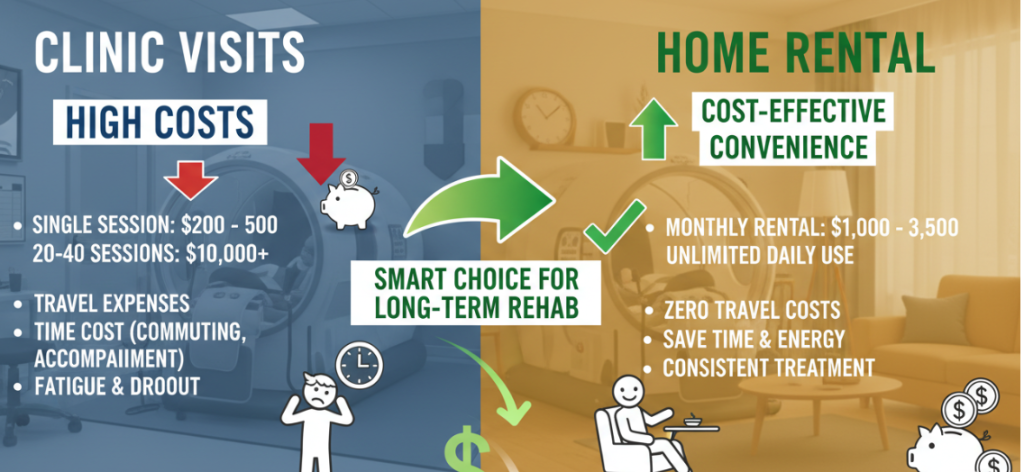
When assessing the financial impact of hyperbaric oxygen therapy (HBOT), the data are very intuitive: for long-term rehabilitation, home rental is the more reasonable option.
Cost efficiency: Clinics typically charge $200 to $500 a single fee. A standard 20 to 40 courses of treatment are done, and the bill is easily over 10,000. By contrast, $1,000 to $3,500 a month for rent allows you to use it unlimited times a day, with a single cost that is negligible.
Eliminate invisible expenses: Apart from medical expenses, the cost of traveling to and from the clinic and the time cost of family accompanying is also a heavy “time tax”. Many patients end up giving up treatment not because it doesn‘t work, but because they are defeated by the fatigue of commuting every day. Leasing perfectly solves this pain point.
“Hard Core” Configuration Of Professional Home Rental Package
The hyperbaric oxygen chambers on the market are mixed. To achieve clinical-level rehabilitation, the hardware must meet the standards and cannot be improvised:
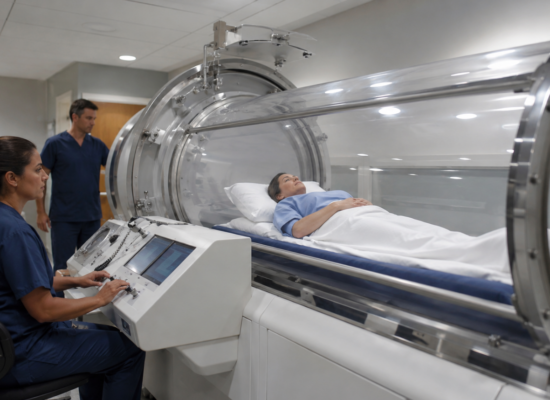
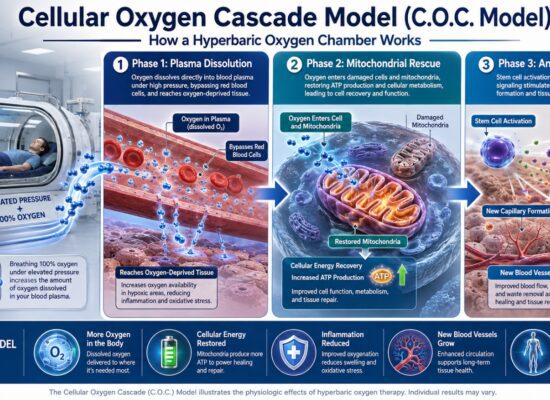
“Soft” cabin (1.3 ATA): The mainstream of household use is this portable soft cabin, which is designed to safely reach 1.3 absolute atmospheric pressure. This pressure level is very exquisite. It can effectively improve the stability of oxygen in plasma, allowing oxygen molecules to penetrate into damaged tissues, while avoiding the possible risks of medical-grade high-pressure hard capsules.
Medical grade oxygen supply system: the cabin is only the shell, the oxygen is the soul. A set of high quality equipment must be equipped with a 5L to 10LPM (liters per minute) medical grade oxygen generator. Only in this way can the chamber maintain a high enough oxygen concentration to trigger the “oxygen saturation” required for cell repair.
Integrated cooling system: This is a detail that is often overlooked. When the air compressor works, it generates heat. If there is no cooling system, the cabin will soon become a “sauna”. Professional rental bags will have their own cooling device to ensure that the cabin temperature is suitable, so that you can lie down comfortably for a course of treatment.
Logistics And Services
In addition to the hardware, the level of service directly determines your recovery experience. In my industry experience, top vendors typically follow a “patient first” logic:
Flexible terms: Look for suppliers who rent on a monthly basis and do not have long-term contracts. This is especially friendly for patients who are recovering after surgery, which usually takes only 4 to 8 weeks.
National reach: high-quality suppliers will provide national distribution services including freight, deliver this heavy equipment directly to the door, and be responsible for logistics recovery after the lease is over.
Safety training: Operating the oxygen chamber requires precision. I think remote mentoring training is the part that absolutely cannot be compromised. The supplier must ensure that you or a caregiver are thoroughly familiar with the compression, monitoring and decompression process before I recommend the patient to start using it.

Achieving Clinical Results At Home
Clinical studies have repeatedly demonstrated that tissue repair, anti-inflammatory and wound healing work best with continuous treatment (usually 5 days per week). In the clinic environment, limited by cost and energy, this high-frequency scheme is difficult to adhere. But at home, you can strictly enforce the protocol, leaving the body in a constant state of hyperoxygenation. This consistency is the key to unlocking the regenerative potential of HBOT, shortening the recovery cycle and improving the effectiveness of chronic disease management.
Author:Gill
As a recovery specialist dedicated to making advanced healing technologies accessible, I have spent years helping post-operative and chronic care patients navigate the complexities of at-home therapy. I advocate for the shift toward hyperbaric rentals because I believe medical-grade recovery shouldn’t be sidelined by high clinical costs or the physical strain of daily travel.

No Comment! Be the first one.